Faceplates, Faceplates, Faceplates Tapped and Embedded For Woodturning
Part of my education in woodturning is to learn what my options are for any particular issue or technique.
When I was first woodturning, my options were spindle turning between centers or bowl turning on a faceplate. I am extremely grateful that scroll chucks were introduced to the woodturning world.
However, I find that there is still a lot of applications for faceplates. However, I rarely use the expensive steel faceplates. Instead, I tap some inexpensive poplar which then is adapted to current needs.
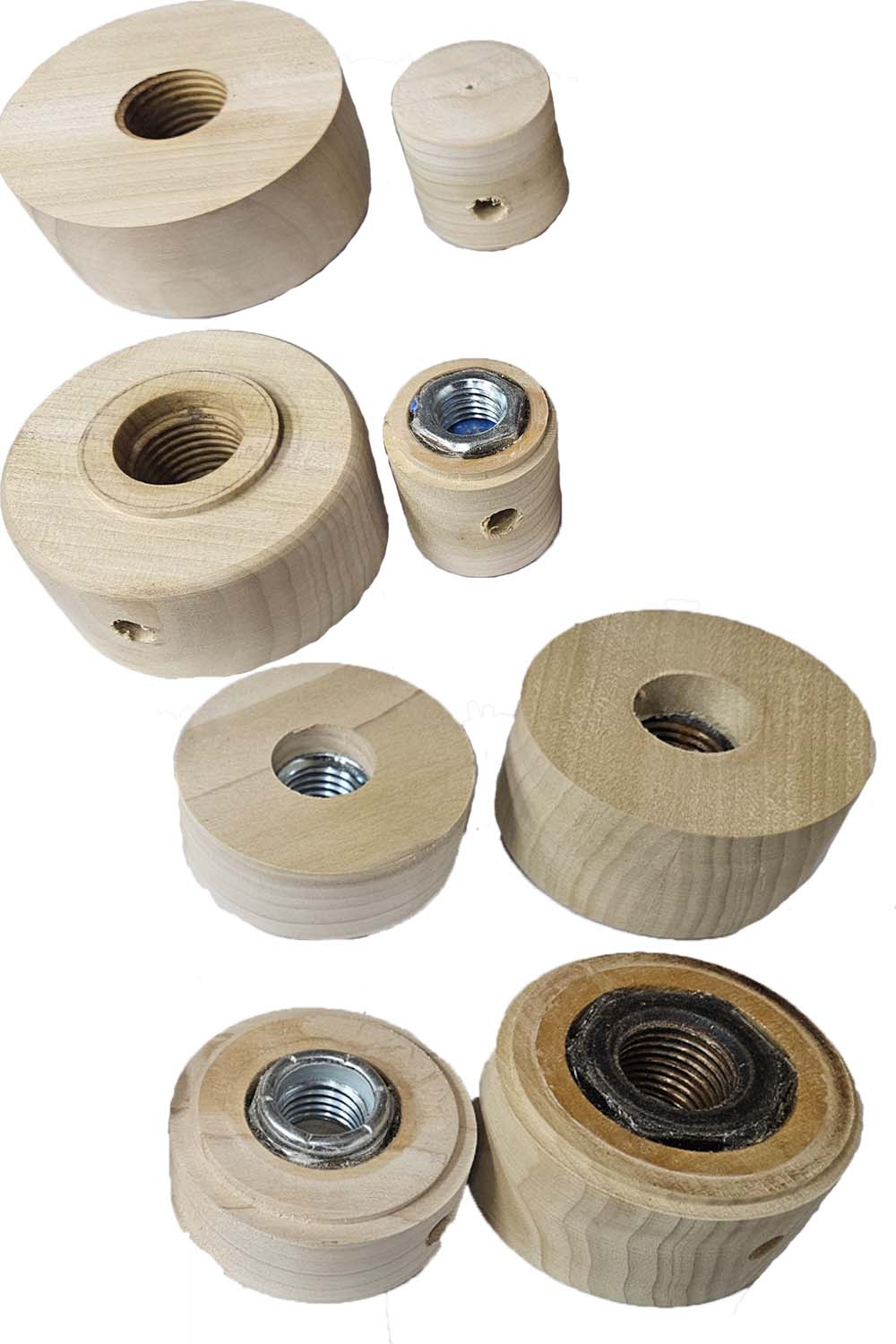
But there is still a lot of discussion about using steel nuts to make a faceplate. I was introduced early on to using a tap to tap my own faceplates. Therefore, for this video, I am illustrating creating wood faceplates using three principle sizes used in woodturning: 1.25″ x 8 tpi; 1.00″ x 8 tpi; and 0.75″ x 10 tpi.
Spoiler alert. The only nut that comes close is a 1.00″ nut. Even then, the nut must be a more expensive Nyloc nut due to spindle construction.
1.25″ nuts suffer from being very specialized, rare, expensive, and heavy. There are no Nyloc options which make this a poor options for most lathes.
0.75″ nuts can also work if adapters are available for the lathe spindle.
I typically start with 3-4″ square of 1.5-2.0″ poplar. The wood much be cross grain. Other close grain woods such as maple also work well except they are more expensive. Early on, I felt I needed to tap for large faceplates. However, as my practice has evolved, I stick to the 3-4″ square and then add on additional layers. When adapting the faceplate for spindle used, I use a mortise and tenon approach to have spindle orientation as needed. When a project is finished, I face off the template for the next project. When the working layer gets too thin, I simply glue on another piece of scrap wood.
I use dozens of these.
Enjoy.
p.s. Would you like a more in depth demonstration? Please contact me for an IRD (Zoom Demo) on this or other topics.
If you happen to have technical difficulties, this video is also posted on YouTube (link).. But it is best right here. So stick around.