Woodturning Green Chestnut Bowl – Stitched & Revisited
 This video is also posted to YouTube, Vimeo, and FaceBook. Best Right Here!
After turning a green chestnut bowl a few weeks ago in a style new to me, I had the chance to have feedback from Paul Russell, who had demonstrated it. I wanted to know why the green wood had not warped into a wavy rim like his had.
After receiving the feedback, I turned another thinner, smaller base, and more shallow. I was still disappointed in the amount of warping.
I still had a slice off the same block, so I tried again. Much to my dismay, the chestnut was not strong enough to turn that thin. It split into two pieces and another partial crack.
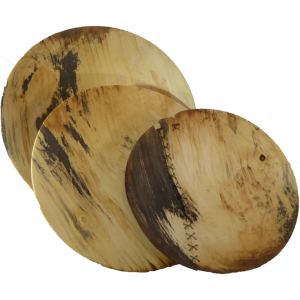
Do I throw it into the fire? No, I used blackened copper wire to stitch the two pieces together.
Maybe not as wavy as I wanted. But it definitely has a story especially when placed with the other two similar bowls from the same block of wood.
Enjoy!
Woodturning Basic Skill Demo Box With Near Suction Fit
 This video is also posted to YouTube, Vimeo, and FaceBook. Best Right HERE!
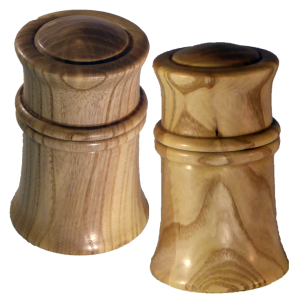
My brother came for a visit and wanted me to demonstrate woodturning a box. I would rather have coached him to turn the box. However, that is all he had time for.
An end grain box is always a good project with lots of potential. Boxes can be both useful and pretty. Many woodturners aim for a suction fit at the joint between the top and the bottom. While this fit may demonstrate skill, the end owner of the box then often must use two hands to open the box. I prefer to make a tight fit to aid in turning the box but relax the fit just before finishing.
The basic process is:
- Mount wood between centers and round off the wood.
- Cut tenons on both ends of the box to fit a scroll chuck.
- Mount the wood in the chuck, true the rough rounding, and part off the top from the bottom at about 66% of the height, allowing for a tenon.
- Mount the lid in the chuck, hollow, and cut a mortise ensuring the sides of the mortise are parallel.
- Sand and finish the inside of the lid.
- Mount the bottom in the chuck and cut a tenon to fit the mortise on the lid. Sneak up on the fit. If the fit is too loose, waste off the tenon and try again.
- Place the lid on the base, position the live center for security, and shape the exterior.
- Sand and finish the lid.
- Sand and finish the base.
- Relax the joint between the lid and the base.
- Reverse the base into a chuck for a jam chuck.
- Finish shape the bottom, sand and finish.
Once the basic process is mastered, many variations and refinements are possible. Wax is a great finish for the interior to avoid trapping strong odors that will persist for a long time.
I prefer finishes that can blend together as the box is finished in stages. These are generally, wax, oils, shellac, or lacquer. Finishes that do not blend well are surface films such as polyurethane or stains.
Enjoy!
A DIY Approach To Waterproof Wood
This video is also posted to YouTube, Vimeo, and FaceBook. But, you’re already here!
At last fall’s Segmented Woodturning Symposium, I had a discussion with Joe Schlawin. He suggested that acrylic plastic could be used to waterproof certain woodturnings. I needed to know how a solid sheet of acrylic plastic could waterproof the inside of a vase.
It turns out that acetone can dissolve acrylic. It takes some time but acetone can dissolve the plastic.
For this project, I broke up some acrylic into small pieces with pliers. I had to wear my full face shield. The pieces tended to shatter a fly away including at my face. I put about 3/4 inch of small pieces in a pint glass jar with a metal lid. Over the next two weeks, I stirred the mixture and added more acetone. I was amazed when the acrylic changed to a thick syrup. I added more acetone to thin it down.
For the test, I hollowed four cups from cedar. Two of them, I painted the inside only with the syrupy acrylic. It dried hard within a couple of hours – I did not constantly watch them. After drying, I did not detect an unusual odor other than the cedar scent.
Each cup was filled with water and a few drops of red food color. Within minutes, the uncoated cups leaked. One coated cup showed no color on the outside. One coated cup showed color but I think that come over the lip when I moved it.
I have yet to test this process on the outside of a project. But I like what it did so far to the inside.
Is this mix “Food Safe”?
In our current legal environment, it will be difficult to get anyone to say “Food Safe”. You will have to make up your own mind.
However,
- Please google acrylic and food safe. if you follow the same threads that I did, you’ll see that acrylic is okay.
- Acetone is very flammable therefore very volatile and evaporates quickly. It is a common solvent. If you google it, you may find that certain levels are common in the body and higher if someone is on a Keto diet. Acetone is a common ingredient in paint.
- Very little acetone will remain in the finish when dry. The key will be letting it dry enough for you to be comfortable.
So. that is a very long winded way to say that you have to make up you own mind after your own research.
Enjoy!
Woodturning Heart For My Valentine Plus A Collet Flop
 This video is also posted to YouTube, Vimeo and FaceBook. Except that you’re already here!
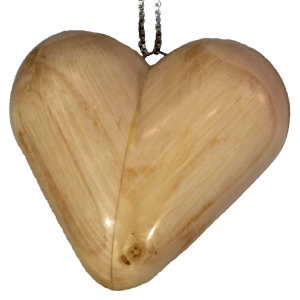
This is an early release for Valentine’s Day. I turned this hazelwood heart for my wife. It is turned from a 7/8″ cylinder which is then sliced at a steep angle. The two parts are then rotated and reglued to form a heart.
In the process, I tried to make and use a wooden collet to hold the cylinder. The wooden collet is modeled after steel collets used in metal working. My collet failed but I think the concept could be useful in woodturning. Please view this video and add your suggestions.
Happy Valentine’s Day.
Enjoy!
Woodturning Maple Mortar and Pestle
 This video is also posted on YouTube, Vimeo, and FaceBook. However, you’re already right where you need to be.
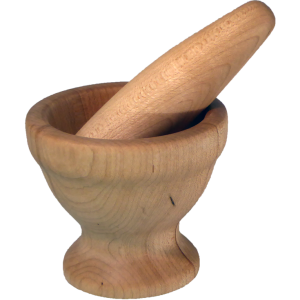
A mortar and pestle has been on my to-do list for a long time. Finally, I found my “round-2-it”. I did have to look up which piece was the mortar and which was the pestle. It turns out that the mortar is the dish part.
I choose hard maple as a dense, non toxic wood. I eliminated others such as walnut and laburnum since they are toxic. I did not want any risk of anything bleeding out of the wood.
To finish, I did the final sanding with a 25-75 mix of beeswax and mineral oil.
Enjoy!
Woodturning Quick and Easy Padauk Plate
 This video is also posted at YouTube, Vimeo, and FaceBook – Where Best? Right Here!
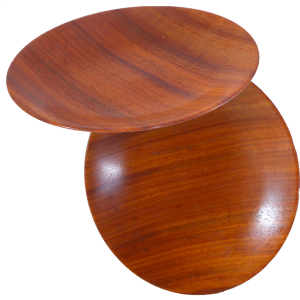
This piece of padauk has been bothering me. It is an offcut from a previous project. I’d like to use it for a segmented project but it is not enough. Finally, I decided to turn a small plate. The padauk is perfect!.
The plate is 7″ diameter finished with lacquer and buffed to a nice shine. BTW, I kept the mounting mortise to about 3/16″, the deepest I would every allow.
This is a quick and easy project. What are your quick and easy projects?
Enjoy!
Resources
- Respirator
- 3M Half Facepiece Reusable Respirator 6200/07025(AAD), Respiratory Protection on Amazon
- Filters
- Advanced Particulate Filter 2291, P100 Respiratory Protection on Amazon
- Home Made Vaporizer for “Pyrography”/Woodburning
- DIY Pyrography Pen And Tip For My Woodburning
Final Woodturning Matching Green Cored Bowls
 This video is also posted to YouTube, Vimeo, and FaceBook. Best right here!
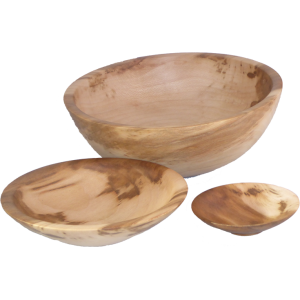
I took a training class at Craft Supplies almost two years ago. During the class, I did a couple of coring projects with the Kelton McNaughton Center Saver System. At that time, I cored two sets of matching bowls from sycamore. I then painted the rough bowls with Tree Saver Green Wood Sealer, brought them home and let them dry. They are definitely dry now – I don’t need to weigh them.
A viewer asked a question, “How to you remount a cored bowl that does not have an original center”. A perfect excuse to rescue those bowls from the drying rack.
In this video, I used two different ways to center the blank. In the end, I recommend the later.
First, obtain a piece of clear acryllic from your store a little bigger than the largest bowl you expect to turn. Find the center and mount the acryllic to a faceplate. Stretch some masking tape from the center to the perimeter so marks can be made every inch. With your favorite point tool (skew) scratch concentric circles at one inch increments. Drill a hole in the center big enough for your pencil (1/4″) then drill holes at each ring preferable in a straight line to the perimeter at each ring.
This center finder can be used many ways. In this case, I want to find an optimum center of the warped bowl. Use the center hole to mark it.
But, as I explain in the video, precision may not be necessary. A green bowl shrinks across the grain, often unpredictably. The bowl walls are thick to allow wood to be cut away. Hopefully, they are thick enough to allow some deviation from a “true” (whatever that is) center.
My sycamore bowls are 10+, 7, and 4 inches diameter and 4, 2, 1 inches tall, finished with walnut oil.
Enjoy!
Resource Links
Home Made Vaporizer for “Pyrography”/Woodburning
DIY Pyrography Pen And Tip For My Woodburning
Woodturning & Hollowing A Vase – Not Through This Neck
 This video is also posted to YouTube, Vimeo, and FaceBook. But best right here!
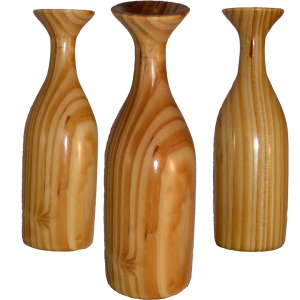
Why hollow through a tiny hole if you don’t have to. For this long neck vase I hollowed it from the bottom then plugged the hole with matching wood.
Watch out for hanging out so far from the spindle. I used my DIY steady rest to stabilize the long spindle.
My cedar was harvested near Portland Oregon. An arborist identified it as Titan Cedar, a close relative of biblical cedars of Lebanon.
My vase is about 2 inches diameter and 8 inches tall finished with lacquer buffed to a high gloss.
Enjoy!
Resources
Home Made Vaporizer for “Pyrography”/Woodburning
DIY Pyrography Pen And Tip For My Woodburning
Update To My DIY Lathe Steady Rest
Woodturning Giant Tagua Miniature Vase
 This video is also posted to YouTube, Vimeo, and FaceBook. – Best Right Here!
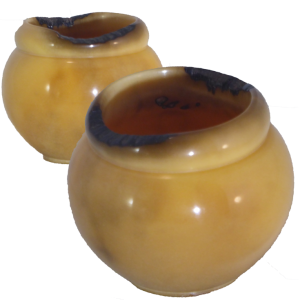
After I turned a miniature vase from tagua a year ago, a viewer, Terry, gave me a bag of giant tagua nuts at last year’s Utah Woodturning Symposium. I did not know tagua nuts could be this big. I wish I knew where to buy more.
This tagua vase is about 2 inches in diameter. No finish is necessary after fine sanding and buffing. Following tagua tradition, I left a bit of natural edge.
Enjoy!
My steady rest:
Update To My DIY Lathe Steady Rest
Woodturning Green Chestnut Bowl – Hoping For It To Warp
 This video is also posted to YouTube, Vimeo, and FaceBook. Best Right Here.
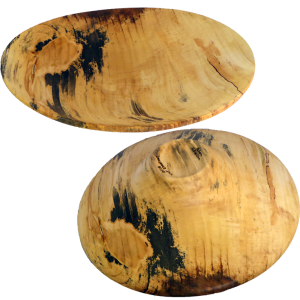
I want to turn this green chestnut to a somewhat different style that I saw recently at a club demo. This bowl does not require a constant wall thickness.
Since it is green, I expect it to warp and I hope is has significant warping.
The bowl is about 10 inches diameter and 3 inches high. Walnut oil provides a renewable finish.
I wish it would warp even more.
PS. The demo was by Paul Russell. I had him critique this piece to compare it to his demo. He did a 20 inch piece – mine is 10 inch. He suggested a more shallow cove in the top, thinner wall, and shorter foot. Now I need to try it again. 🙂
Enjoy!