Woodturning Ugly Duckling Wood Into Beautiful Swan Bowl
 May also be viewed on YouTube and Vimeo.
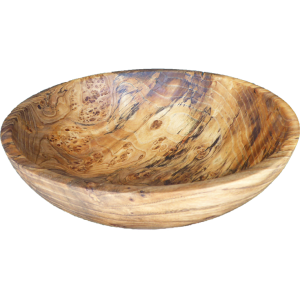
I was given this wood at a club meeting in Oregon. I don’t recall whether it was at Cascade Woodturners or Willamette Valley Woodturners. It is ugly but has some burl potential. I don’t know what species of wood it is.
At 11 inches in diameter, 4 inches tall and finished with walnut oil, it has turned out very nice despite worm holes, drying checks, spalting, rot, and a general bad smell.
It’s surprising how ugly a blank can be and still have such beauty inside awaiting an opportunity to emerge.
This one will be hard to beat.
If you need Cole jaws, follow this link.
Good turning.
Woodturning Eccentric Twig Vase With Infinite Axis Chuck
 May also be viewed on YouTube and Vimeo – Best right here.
I’m still exploring different ways to use the Infinite Axis Chuck. In this video, I turn twig vase or bud vase from apple limb wood finished with a mix of beeswax and mineral oil.
In eccentric turnings, having tail stock pressure provides both security to the wood and can be used to define axis offsets. However, if the turning is small or at least the top of the turning is small, tail stock adjustment is limited or cannot be used at all. To counter these issues, I turned a large plug with a tenon or dowel on one side. In use, the dowel or tenon is inserted into the neck of the vase giving it a temporary and removable top. With a large top, tail stock adjustments can be used and pressure maintained.
I believe it necessary to work from the top or tail stock end down the spindle. Otherwise, the greater mass of wood is on the other side of very thin wood from the drive center leading to one cause of spindle failure. Another cause is tail stock pressure greater than the spindle can withstand. Excess pressure is a tougher problem to solve since some pressure is desireable.
Please check my previous videos on how to make the egg chuck and then how to adapt it to become an Infinite Axis Chuck.
- Woodturning Jewelry With Infinite Axis Chuck
- Woodturn Simple Egg Chuck From PVC Fitting
- Woodturn My Eggs Easy Over Please
Good turning.
To Sit Or To Stand At the Lathe That Is The Question
May also be viewed on YouTube and Vimeo – but best right here.
Many viewers noticed that I was sitting on a tall stool while turning last week’s project. Some needed help due to disabilities.
In this video, let’s discuss this issue and explore alternatives.
Please add your experiences and suggestions.
Good turning.
Eccentric Spindle Woodturning With Infinite Axis Chuck
May also be viewed on YouTube and Vimeo – But best right here.
Since adapting the egg chuck into an Infinite Axis Chuck, I wanted to explore other ways that it can be used.
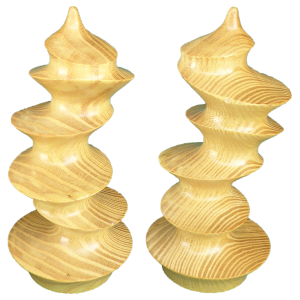
I used hot melt glue to fasten his piece of elm to the chuck’s tenon. Then working from the top down, I turned a series of coves and adjusted the axis a little bit with each cove. Each adjustment moved the axis between 90 and 120 degrees and increased offset from the original axis.
The finish is friction polish buffed.
This turning has no resemblance and no useful purpose. That means it must be pure art.
Good turning.
Woodturning Jewelry With Infinite Axis Chuck
May also be viewed in YouTube – Better right here!
 In this video, I adapt the egg chuck I demonstrated about a year ago. Instead of an egg, I turned a ball and socket tenon to fit the chuck. Then I used this new Infinite Axis chuck to turn a jewelry brooch or pin.
The pin is glued up from maple, walnut, honey locust, and padauk finished with friction polish. The brooch has three features requiring a skew axis.
Often in eccentric turning, the wood is shifted on a faceplate to cut in a feature. This is an example of a parallel axis. When the work is tilted so that the new axis is not parallel to the original turning axis or not perpendicular to the face of the project, this is a skew axis.
To adapt the egg chuck to become an infinite axis chuck, I turned a ball or sphere on the end of a piece of cedar. (Most any wood would do.) However, instead of forming the small end of an egg, I turned an extended tenon. This tenon must then fit thru a retaining ring and the threaded PVC fitting ring.
Follow this link to “Woodturn My Eggs Easy Over Please”
Follow this link to “Woodturn Simple Egg Chuck From PVC Fitting”
The retaining ring is HDPE, high density polyethylene, instead of wood due to the size of the center hole. The short grain of wood would crack and break with this small section. While turning the retaining ring a short tenon that fits the PVC ring serves as a mounting tenon to turn the reverse side of the plastic.
Good turning.
Woodturning Jewelry – Multi-Axis Necklace or Brooch
May also be viewed on YouTube – But best right here.
In this video, I’m trying out another project from the 2016 Utah Woodturning Symposium. Again, I credit Linda Ferber.
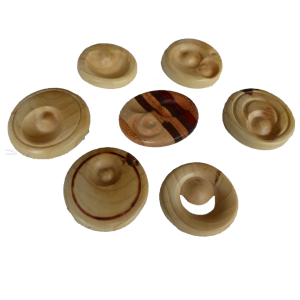
These are thin wood disks with decorations like buttons turned on the face. To turn these buttons, I used a very cheap, easily made chuck to fit my usual chuck. The chuck tilts the turning axis away from parallel. This gives the turning a unique look.
I turned a chunk of cedar round with dove tail tenons on both ends. Then at a chop saw, I clamped the wood to the saw and sawed a 20 degree cut. Then adjusted the cut to 10 degrees and trimmed the wood a little more. This yielded two chucks that I’ll call skew axis chucks. I used hot melt glue to mount wood disks to the chucks although I recommend double stick tape.
The brooch is turned first as a cylinder then about one quarter inch is parted off after cleaning up what will become the back side. Then the disk is flipped over and fastened back onto the cylinder it just came from. This mount enable the face to be trimmed and sanded. Then the disk is mounted yet again to one of the skew axis chucks in any desired offset from center. A button can then be very carefully cut and sanded. On some brooches, I offset the disk up to three times for different decorations.
Most brooches were apple wood. One was from a multi-wood blank from a previous project. Each was finished with shellac and buffed.
Afterwards, I glued on a finding from Fire Mountain Gems that allows the brooch to be either a necklace brooch or a pin.
Good turning.
Woodturning A Natural Edge Necklace Pendant
May also be viewed on YouTube – But best right here!
I enjoyed the 2016 Utah Woodturning Symposium. I plan to soon turn my version of many projects and techniques I saw there. The inspiration for this one is Linda Ferber, who makes wood components to jewelry.
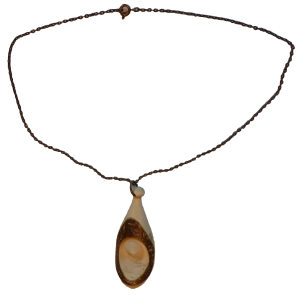
This pendant is hazelwood pruned from my back yard. I mounted it in my home made wood chuck jaws to turn a small button on its side. The wood was tilted to put the button on a different axis for more interest. After turning the button, I remounted the wood between centers. However, I also offset the turning axis toward the side with the button. As a result, as I turned a teardrop shape, the bark formed a natural edge border around the button. After finishing with shellac, I buffed this amazingly white wood and mounted a jump ring to connect it to a necklace.
It was a fun little project that I will do more with.
Good turning.
Utah Woodturning Symposium – My 2016 Egg Cup Race Entry
May also be viewed on YouTube – But best right here.
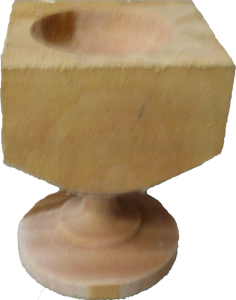
I enjoy attending woodturning symposium – the Utah Woodturning Symposium is one such treat. In addition to all the demonstrations and exhibits, an annual feature is the egg cup race. I’ve participated for at least three years. It is a lot of fun.
Each participant is given a block of green wood with a tenon already turned and mounted in a lathe. Two woodturners turn at the same time competing either for the fastest egg cup or the best egg cup in less then two minutes. There was a healty mix of presenters, professionals, experienced and not-yet-experienced turners.
I finished my egg cup in one minute and thirty eight seconds. Respectable. However, I left my egg cup square in the cup portion – a different design. Good or Not, that was it.
Good turning.
Woodturning My Grandson’s Wood Ball With Bell Inside
 May also be viewed on YouTube – But best right here!
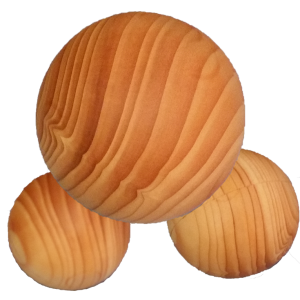
After visiting my grandson I wanted to turn something appropriate for his age. However, he’s 18 months and probably too old for a typical baby rattle. He’s very active so I decided to make a ball. However, a wood ball can be quite heavy and potentially destructive. A hollow ball reduces this risk. However, a little noise to go with the ball. A metal bell does the trick. But since the ball could break, I need the bell to be big enough that he cannot swallow it since everything and anything goes into an infant’s mouth. So I used a larger bell at 1.25″.
To be food safe, I finished the ball with mineral oil and beeswax which turns out to be my sanding media. So, as I sand the ball, I’m finishing it also. A fringe benefit is to soften my hands and scent the air with a little honey smell.
My ball is 3″ in diameter from cedar harvested from a tree in my backyard.
Here’s a link to the octagon chart.
Good turning.
Woodturning A Summer Ice Cream Delight
Video may also be viewed on YouTube – But best right here.
I’m still not at home in my new shop but that is not going to stop me from turning.
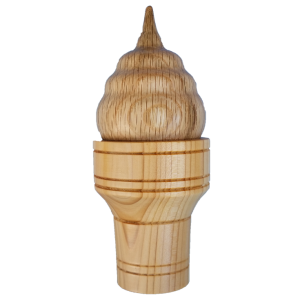
After enjoying ice cream with my granddaughters, I decided to attempt to turn an ice cream cone.
My ice cream is turned from cedar for the cone and oak for the ice cream. Both woods are products of urban forestry. The cedar came from a tree that was in my back yard. The oak came from a friend’s neighbor after a storm damaged their tree.
The complete ice cream serving is about 5 inches tall and 2 inches diameter finished with Mylands Friction Polish.
The question now is along the ice cream theme. What else could I do to transform or enhance my ice cream? Hmmmm.
Good turning.