Woodturn Art – Spirit Of A Wave
May also be viewed on YouTube.
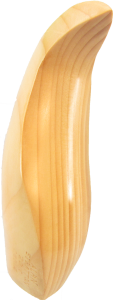
This project is my chance to practice what I learned from a demo by Eric Lofstrom at the Oregon Woodturning Symposium.
The wood is cedar from my backyard tree. It is turned with four axes that created three curved facets. The primary axis is the normal center; the other three axes are at 120 degrees. I cut a large cove on one facet and large beads on the other two.
Most wood removal was with a gouge with refinement with a skew.
Multi-axis turning is rough going as there’s no bevel to ride. After the lathe work, I band sawed the top into a flowing shape; the bottom to a flat. Afterwards, I refined the shapes by sanding.
The final shape is about five to six inches tall and two to three inches in diameter. It is finished with shellac. Buffing made a world of difference to the finish. Check him out at http://www.ericlofstrom.com.
My thanks to Eric for opening to me a new dimension in woodturning.
Woodturning Fascination – A Woodpecker Toy
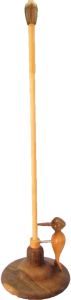
This woodpecker toy has been on my To Do list for a very long time.
The original was a small bird perched on a spring mounted on a small tube that fit over a stiff wire. The bird would rock back and for while travelling down the rod.
He’s truly fascinating.
This version is upscale from the original with more travel on a longer dowel. The bird is cherry and walnut. The spring came from a hardware store selected because it seems not to stiff and not too weak. The spring mounts to a short wood tube that fits loosely on a 5/16″ dowel. The dowel is mounted to a walnut base and topped with a cherry cap. The base has a taller center to try to protect the bird’s tail when it reaches bottom.
After some trial and error, the bird does his thing, rocking back and forth as he travels down the dowel.
Woodturn Simple Egg Chuck From PVC Fitting
May also be viewed on YouTube.
My friend, Jerry Klug wrote an article for Cascade Woodturners on turned eggs and chucks for making eggs. This video will focus on my adaptation of these chucks for my use.
One early chuck was from Dick Sing using PVC slip fitting. It works on a compression principle with the force supplied by a band clamp. In my opinion, its disadvantage is the risk of personal injury from the band clamp.
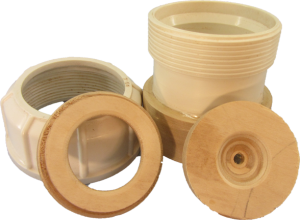
The second chuck was from Vern Bunn using a PVC threaded coupling (2 in PVC S x S Compression Coupling). It works differently in that the compression comes from the top ring of the PVC fitting which is threaded. It has a slightly greater range of egg sizes. In my opinion it would serve somewhat better than Dick Sing’s.
However, even this chuck can be improved. Vern’s implementation holds the PVC with his four jaw chuck. I’d rather not tie up my four jaw chuck. Plus, ideally, jaws should be positioned in the same position with each use. Both of these conditions can be avoided by mounting the PVC on a home-made (DIY) threaded faceplate. My faceplate is poplar but could be made of any appropriate material.
Steps:
- Make a threaded faceplate.
- Smooth the outer surface of the PVC then part it in about half.
- Cut a groove in the faceplate to fit the PVC fitting. Then glue the PVC into the groove.
- Make at least one wood disc for the bottom of the chuck. It must fit into the PVC and be dished out to fit the bottom of the egg. Additional spacers may need to be added as necessary.
- Make at least one wood ring for the top of the chuck. This ring fits over the small end of the egg but inside the PVC female threaded ring.
Then use this chuck to finish the small end of your eggs as smoothly ands well finished as the rest of the egg.
Link to Jerry Klug’s article: http://www.cascadewoodturners.com/newsletters/TurningTimes0215.pdf
Woodturn My Eggs Easy Over Please
May also be viewed on YouTube.
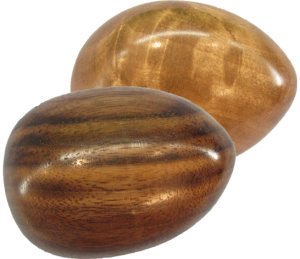 This project is a fun way to use up scraps and please both the grandkids and their parents.
This time, I’ll use a egg chuck derived from work done by Vern Bunn. The main difference is that I’ve mounted mine to a threaded wood faceplate to avoid using my 4 jaw chuck.
According to Ron Washall, the perfect egg is a series of arcs: one describes the bottom, the big end; 2 identical arcs define the sides; and one more describes the top. However, you will never find a “perfect” egg. They are all different. But, calculating from his description, the perfect length for an egg is 1.29 times its diameter. I made several templates to help me with this measure.
All this was compiled by Jerry Klug in the February newsletter for Cascade Woodturners.
The two eggs in this video are both walnut of different types. They are finished with shellac friction polish. They are about 1 3/4″ diameter and, of course, their lengths are 1.29 times their diameter. Approximately of course.
All this is just in time for those spring egg hunts. 🙂
Link to Jerry Klug’s article: http://www.cascadewoodturners.com/newsletters/TurningTimes0215.pdf
Link to Fitting
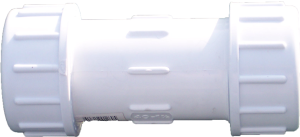 http://www.homedepot.com/p/Mueller-Global-2-in-PVC-S-x-S-Compression-Coupling-160-108HC/202283769
Woodturn Segmented Hash – Art From Leftovers
 Also may be viewed on YouTube.
Leftover Time!
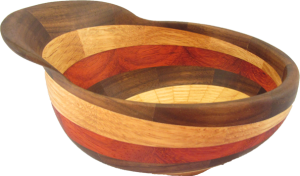
I’ve accumulated some segment rings leftovers from previous projects. Most are from my Crazy Droopy bowl that have a taper on the rings. Rather than make new rings, I’ll make these into this project.
The first two rings are flat and not very tall. These will make the base. The first is cherry with 12 segments; the second is oak with 24 segments. These I glued to a threaded wood faceplate.
The next rings are 8 segment rings of walnut, padauk, oak and walnut. These total 69 segments including the walnut plug in the base. All of these rings have a taper.
This bowl presented a challenge in gluing the rings to the base as they had a strong tendency to slide and were difficult to clamp. Actual turning resembled multi-axis turning and natural edge turning. I carved three feet into the foot instead of a round base.
Not bad for leftovers!
The bowl is 5 to 6 inches in diameter and 2 to 3 inches in height finished with walnut oil.
Remount and Finish Bowl – No Rush To Finish Russian Olive
May also be viewed on YouTube.
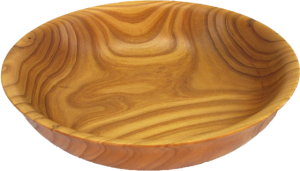
This bowl is turned from Russian olive from Idaho. It is generally considered a weed tree, planted for wind protection. It is now classified as a invasive species.
My sons’s in-laws had not qualms over cutting down with the tree. I rescued several chunks from the burn pile to take home and turn. I’ve never before turned Russian olive. Looking at the log’s end grain, all that I could see was a medium brown color.
When roughing the bowl, the wood seemed somewhat dry – definitely not as much water as other woods I’ve rough turned. I roughed it out anyway, waxed it and set it aside to dry.
After a couple of years, it’s ready to remount and turn. Since I did not then keep the nub on the bottom to mark the center, I used my cole jaws to reform the tenon. This had a disadvantage in that now I had to turn the exterior while mounted in a 4 jaw chuck. This meant that I was trapped between the headstock and the bowl. I felt constrained.
Still, I did complete the bowl and soaked it in walnut oil for a finish. The bowl is ten inches in diameter and about two inches in height.
Many would find fault in the soft sections of the grain. They sanded away creating a wave pattern. However, I like the result and may want to magnify the effect in future bowls.
Woodturn A Cherry Goblet Wood’n U Like A Toast
May also be viewed on YouTube.
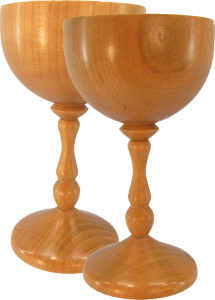
This goblet is turned from a large chunk of cherry given me recently from someone who saw my work in a GEARS exhibition, mainly a metal working show. I’ll give him the goblet in appreciation for a large cherry stump he gave me after the show.
The goblet is 5 inches tall and about 3 inches in diameter. It is finished with shellac friction polish. A goblet is a great exercise, combining skills from a finial and end grain hollowing.
Woodturn Natural Edge Fig Bowl – My Smallest Yet?
May also be viewed on YouTube.
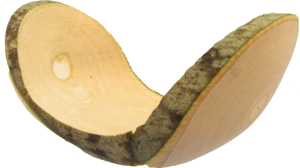
This is another project from pruning my fig tree. It is a bowl turned from this small about 2.5 inch diameter limb.
This project was a challenge due to its size. It is too small to mount in my standard chuck jaws. I have smaller jaws but I do not trust a tenon that small to not shear while I’m turning it. So, after some consideration, this video shows how I turned this small limb bowl. With its natural edge and small diameter, it is cute.
The bowl is about 4 inches long, 2 inches wide and 2 inches tall and finished with walnut oil. It will need more hand sanding when the wet wood dries.
Woodturn Natural Edge Fig Mushroom – Not For Soup
May also be viewed on YouTube.
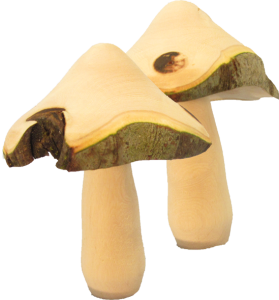
My wife’s sister asked me to turn a mushroom for her. Right now I have cuttings from a fig tree in my front yard.
Why not a natural edge mushroom from this fig. Figs and mushrooms both have nice flavors for cooking, why not see how they go together for a gourmet chef?
The end result is about 3 inches in diameter and 4 inches tall. The bark and limb make a nice irregular natural edge. This mushroom is finished with walnut oil – another flavorful cooking item. 🙂
Since this wood is wet, it will dry, shrink, distort and crack for more character and personality.
Woodturn Natural Edge Winged Tea Light From Fig
Also may be viewed on YouTube.
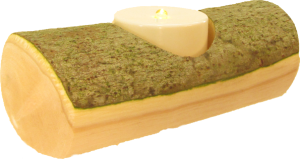
This wood came from a fig tree in my front yard. It’s a small limb but had to go. I’ve never turned fig nor heard of anyone turning it. But why not try.
Although it’s small, it is large enough for a simple tea light. I did not want to just rip the limb in half. I wanted the top surface to be the natural bark from the fig then bend around to a flat on the bottom. This tea light base is 5 inches long and about 2.5 inches in diameter. The light is a battery operated LED tea light. I’d never put a wax candle in a wooden holder.
Since the wood is very green or wet it did not absorb much walnut oil. After it dries, I’ll apply more oil. then we’ll also see how fig turns out.