Woodturning Segmented Decoration (Spoon) Display
This video is best viewed right here(above). In case of difficulty, it is also posted on YouTube and FaceBook.
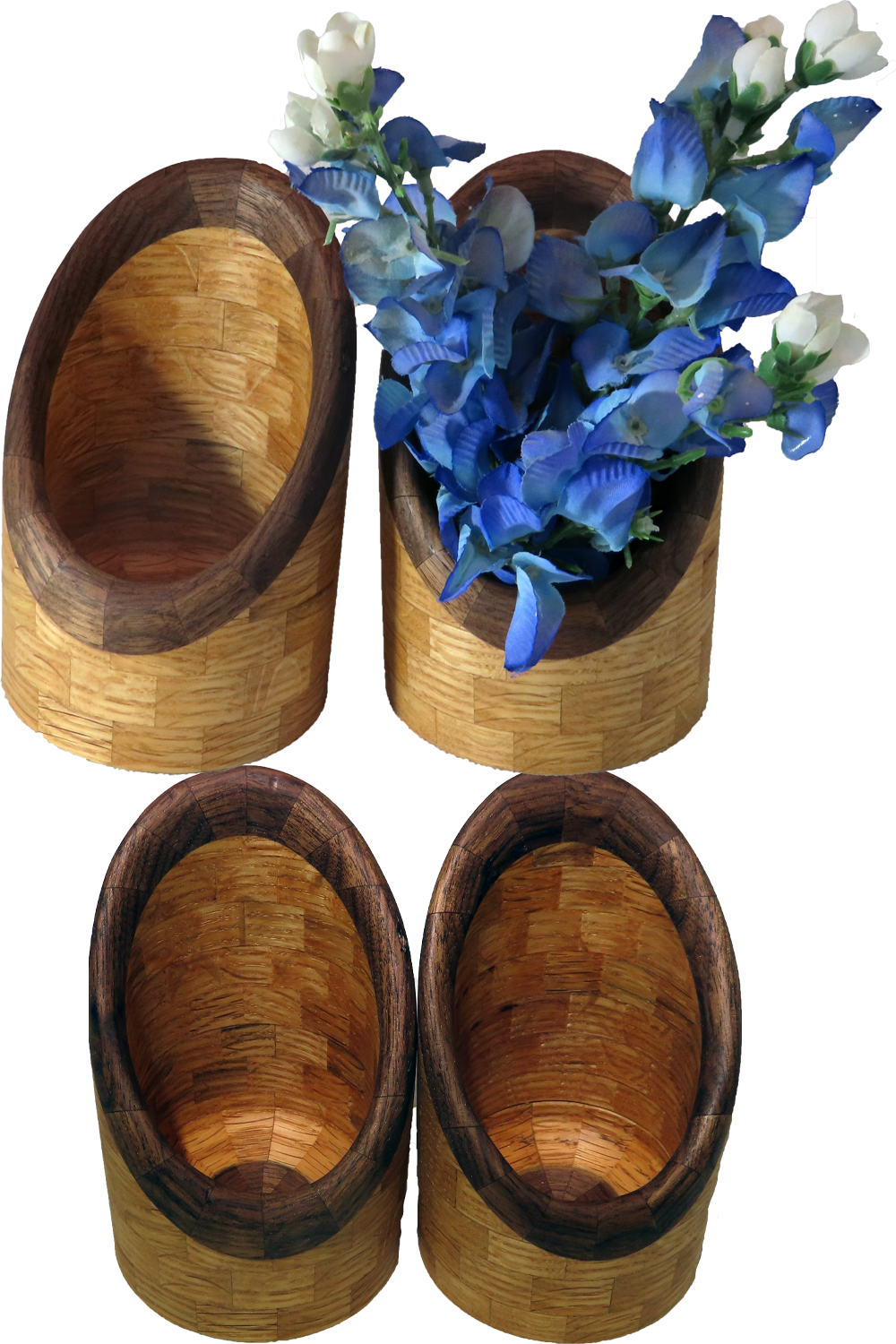
My wife reviews the junk mail ads that come in the mail. When she sees one that she thinks could be turned, she points it out to me. This time it was a specked spoon holder. “Could you make this”. I took one look and seeing the elliptical rim said “No”.
But, the idea bounced around more until I came up with a plan. It turns out that I could use the band saw jig that I have been working on. Then what would should I use. It would require a long cylinder. Solid wood? I could use solid wood. Segmented? Yes. Okay using segmented, I could reate the exact shape that I needed.
How about a accent piece. Solid wood? No problem, I would need two thin pieces longer than the diameter of the cylinder. Segmented? This would require an oval segmented ring. How could I deliberately create an oval segmented ring? After many rounds of thought, it is simple. Add two rectangular segments on opposing sides of a segmented ring. Problem solved. My twelve segment ring would be a fourteen segment ring. All angles would be the same except for the two rectangles.
It turns out that the segmented approach was easier than using solid wood because I could drill half depth cylinders instead of full depth cylinders. Except, I would still need a “clean up” drill at full depth.
While these spoon holders were an experiment, I think this process could be used for other projects. We’ll see…
Each spoon holder is oak with a walnut accent; three inches in diameter; five inches tall; finished with walnut oil. 12 oak segment rings with 12 segments each. 2 walnut rings at 12 segments each. 2 walnut oval rings at 14 segments each. Total segments are 196 segments.
Enjoy!
This year’s Christmas Ornament Challenge opens November 1st. Be ready! There is something for everyone who enters.
Woodturning Multi-Axis Pumpkin Box
This video is best viewed right above here. However, in case of difficulty, it is also posted on YouTube and FaceBook.
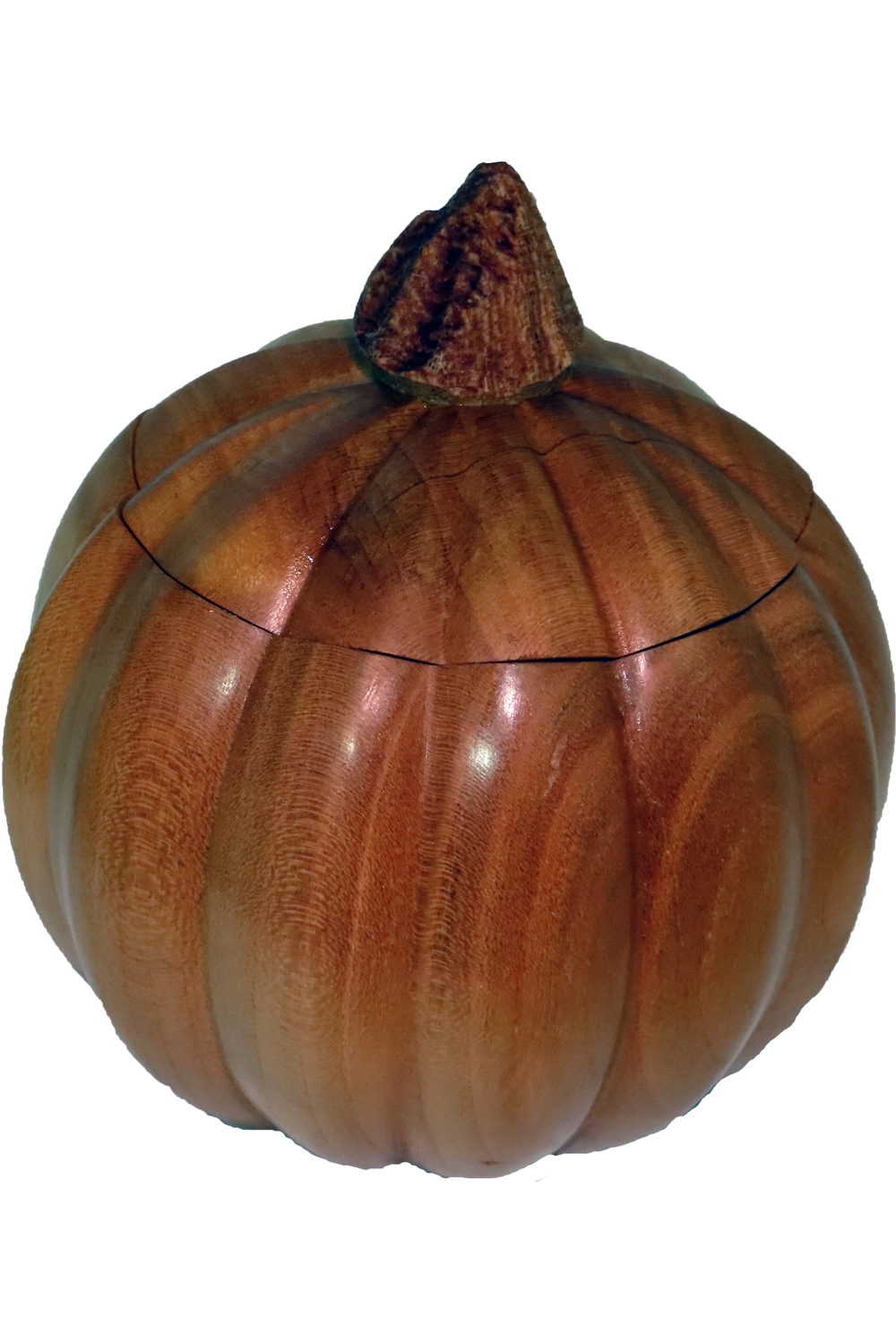
Last year, one of my video projects was a faux sea urchin Christmas ornament. Last week, Tom, a viewer, sent me a picture of a box shaped as a pumpkin that he said was based on my faux sea urchin. I was intrigued. The lid was intersected by the pumpkin ribs. Usually, this would result in fragile short grain tips on the lid or the lid would have to be very small. But no, the ribs were well supported. But how was it done. To save a lot of brain waves, I asked him what process he followed. He was willing to share and welcomed a video for this project.
There are two keys that are very different from most wood boxes:
1) the box joint is at 90 degrees to the tangent at the joint. Usually, box joints are aligned with the turning axis. However, with the joint location the joint is about 45 degrees from the typical.
2) the ribs are cut after the box is hollowed. But to do this, the lid is re-joined with the box using a dowel through the center. The dowel is glued in. Finally, the dowel is drilled out and replaced with the stem.
This pumpkin is about 4.5 inches diameter plus a little more for the stem. The cherry body is finished with shellac friction polish. The stem is mesquite finished with walnut oil.
For a video dedicated to sphere:
Woodturning Perfect Spheres – For Wise Turners
Enjoy!
This year’s Christmas Ornament Challenge opens November 1st. Be ready!
Three Lobe Celtic Knot On Woodturned Segmented Vase
The best place to view this post is with the control above here. However, in case of difficulty, it is also posted on YouTube and FaceBook.
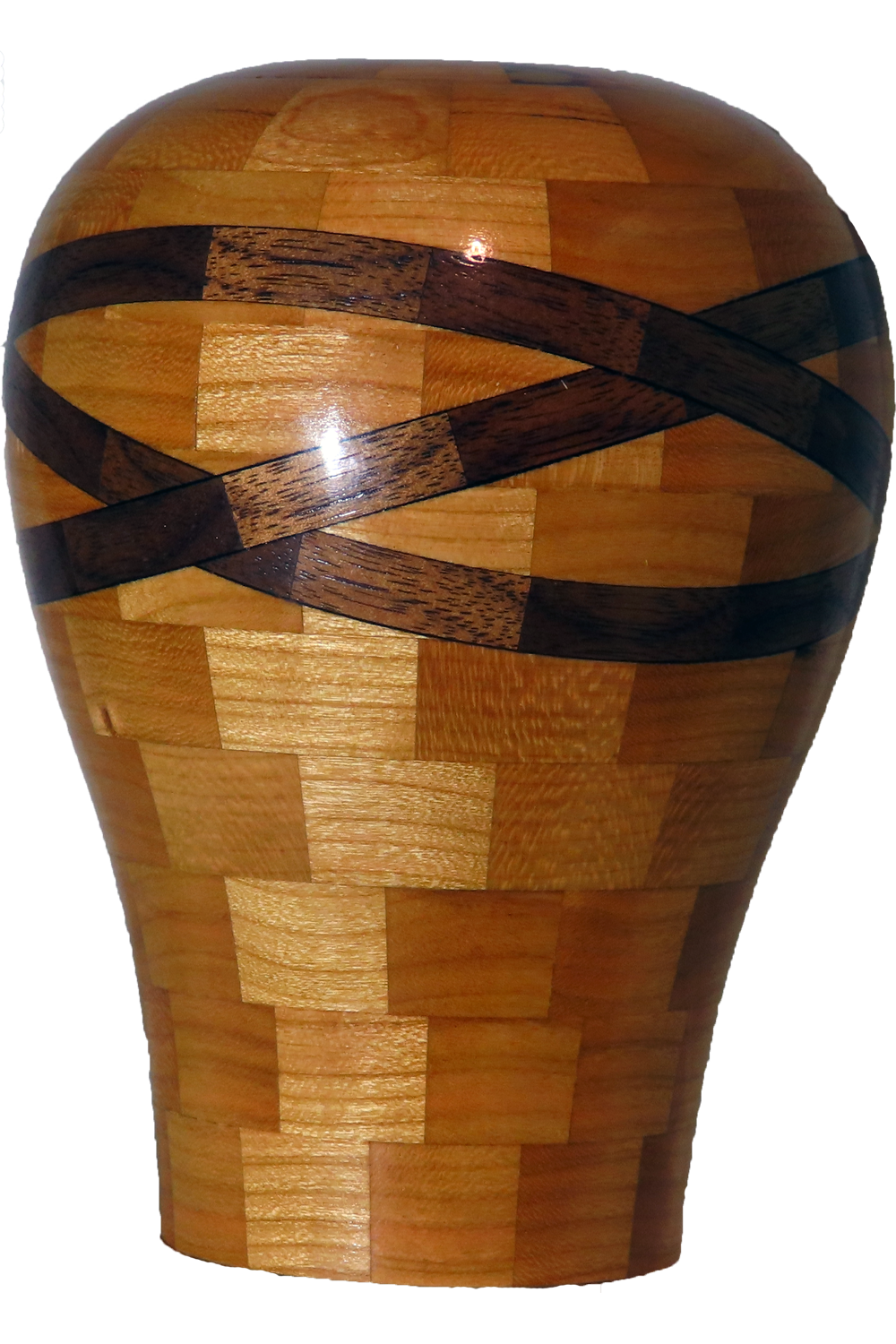
For this vase, I glued eleven cherry rings with twelve segments each and three walnut rings with twelve segments each. This is a total of 168 segments.
The feature area is a Celtic knot with three lobes from the three walnut segment rings. I like triples from an artistic sense. Pen turners who incorporate a Celtic knot typically use two lobes because they use the square stock to make the knot. However, a larger, round project with additional lobes requires a very different process to ensure the wood is aligned for perfect crossings between the rings.
This vase is about five inches in diameter and about 6 inches tall, finished with lacquer and buffed.
Enjoy!
This year’s Christmas Ornament Challenge opens November 1st. Be ready!
Woodturning Bowl – No Cole Jaws For Foot
This is best viewed right here. However, in case of difficulty, it is also posted on YouTube and FaceBook.
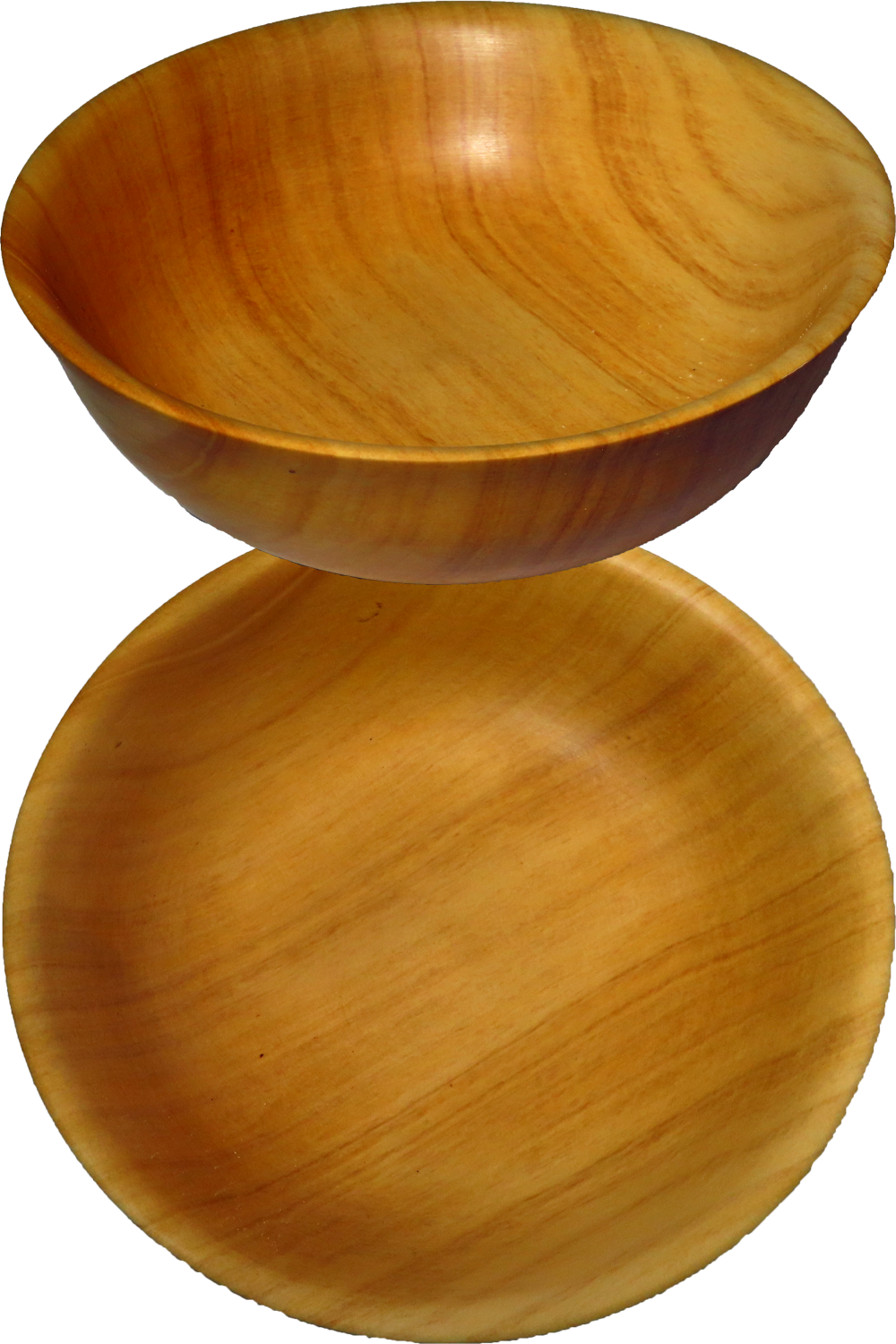
I received this wood, podocarpos, in my club wood exchange. I was not familiar with it but it was a great wood to turn.
Since it was only two inches thick, I did not want to sacrifice any height for a mounting tenon typical in bowl turning. Instead, I used a technique more commonly used for large trays or platters. Instead of using a tenon, I cut a mortise in the bottom.
All too often, when I see a mortise in a bowl turned by others, it is a deep (ugly) mortise. However, with good techniques, the mortise can be shallow and hidden in the bottom.
For this bowl, I decided to buff it. My buffing setup uses a spindle extension “Hold Fast Long Buffing Adapter” and “Beall Bowl Buffs” available in 2,3, and 4″ diameters. (I use 4″).
Enjoy!
Ornament Challenge 2021 Kickoff
This is best viewed in the control above here. However, in case of viewing difficulty, it is also posted on YouTube and FaceBook.
It is time to make your ornament for the 2021 Christmas Ornament Challenge. The time to submit your picture is during the month of November 2021.
This year, there is something for everyone. Grand prizes for the top ornaments selected by public vote and the two hosts in the form of gift cards. Other vendors are providing discount codes for EVERYONE who submits an ornament. The top three craft clubs will receive a free IRD.
This video has all of last years ornaments for your inspiration. Draw from what you see and interpret an ornament your way.
We love to see the pattern of inspiration and people stretching their limits.
For official rules, go to www.OrnamentChallenge.com
For inspiration, go to www.OrnamentChallenge.com
During November, go to www.OrnamentChallenge.com to enter your ornament.
Enjoy!
Woodturning Golden Chain Bowl – A Long Time Coming
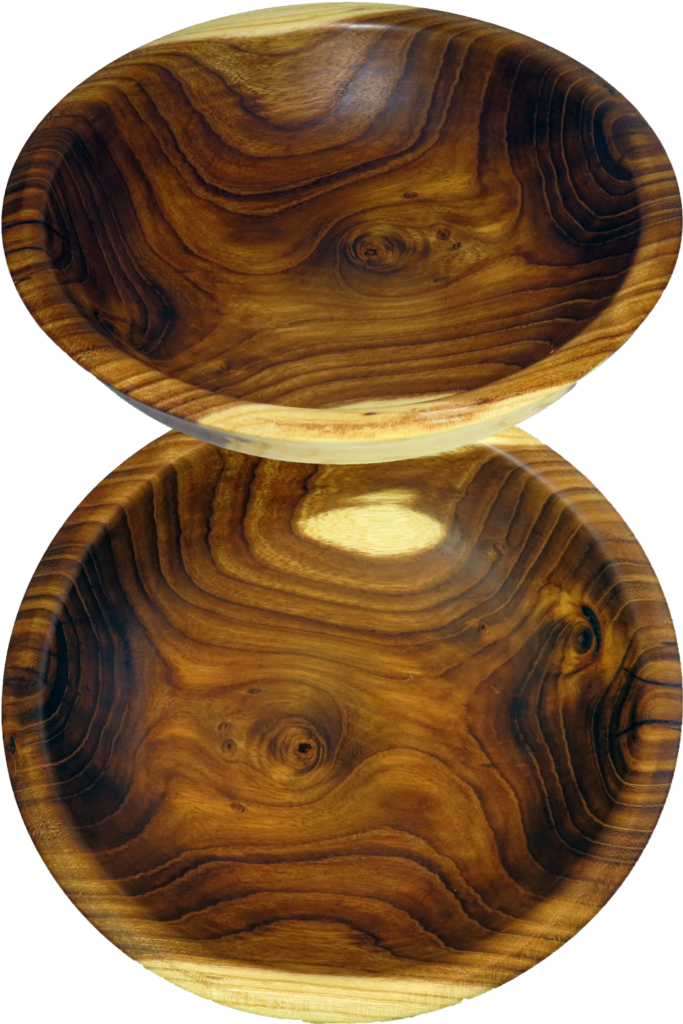
This post is best viewed in the space above here. In case of difficulty, it is also posted on YouTube and FaceBook.
I was not familiar with this wood, Golden Chain, when my Oregon neighbor cut it down. I thought it would be a usual turning experience.
I tried to core some of the wood as I needed practice. I got beat up. That is when I did my research. Golden Chain is native to Europe where it is known as Laburnum. It is toxic in any form to animals. Most importantly, it is very hard and dense and often a substitute for ebony.
Rough turning the wood green into a bowl was not too hard. Wet wood is always a pleasure to turn. I sealed the wood and put it away to dry.
Meanwhile, I moved to Utah and got distracted for about nine years. The wood is definitely dry now. I have to bite the bullet sometime and finish turning it. Yes, very hard and dense. I am happy I did not have to turn the entire bowl while dry.
Laburnum has a beautiful mellow brown color. Sapwood adds a great contrast. It is 8″ diameter; 2″ tall finished with walnut oil and buffed.
Enjoy!
Woodturning Elm Burl Vase That Almost Was Not
This post is best viewed in the control above. However, in case of difficulty, it is also posted on YouTube and FaceBook
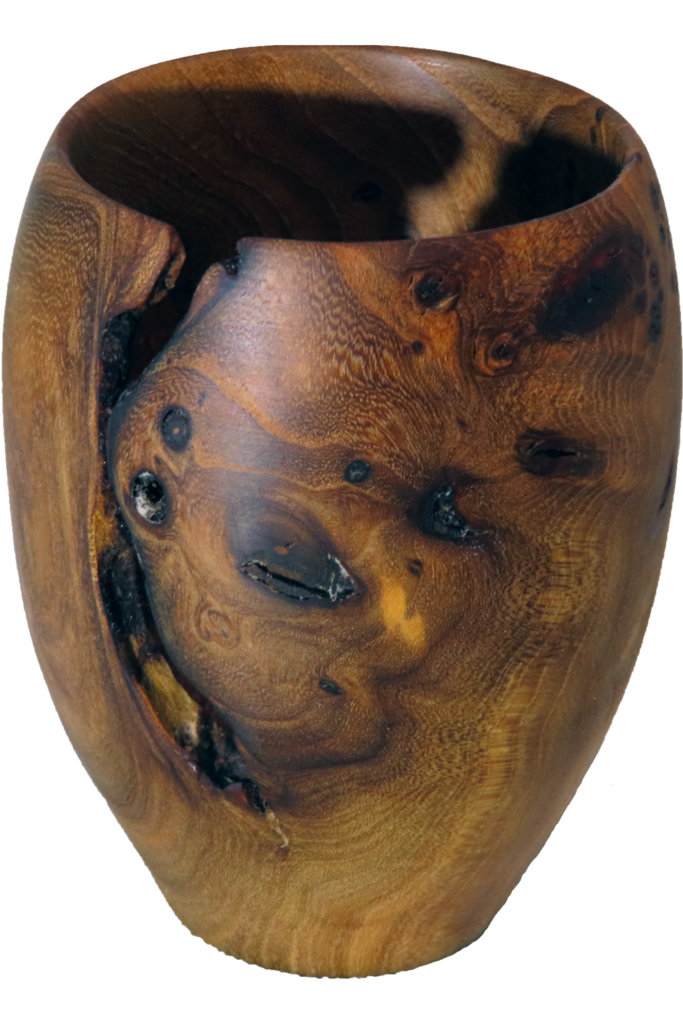
I almost threw this wood out – three times. As wet wood, it was a small left over piece. As rough turned, it looked like it would come apart. In finishing, I feared it would fly apart.
The wood is elm burl, that came from a tree a couple of miles from me. They had cut it into short slices. Not very good for bowls. The finished vase is about 4 inches tall and 3 inches diameter with walnut oil finish.
I used my recently revised doughnut chuck to finish the bottom. This version uses a large base on a threaded wood faceplate with t-nuts at 120 degree intervals. A center hole enables custom center profiles. A hefty ring matches the bolt holes but with enough recess that the bolt heads are below the surface, protecting my hands from accidental contact. An inner mortise holds custom rings for different size projects. It is simple to make.
Enjoy!
Secure Cross Grain Box – 3D Print Meets Woodturning
This post is best viewed above here. In case of difficulty, it is also posted on YouTube and FaceBook.
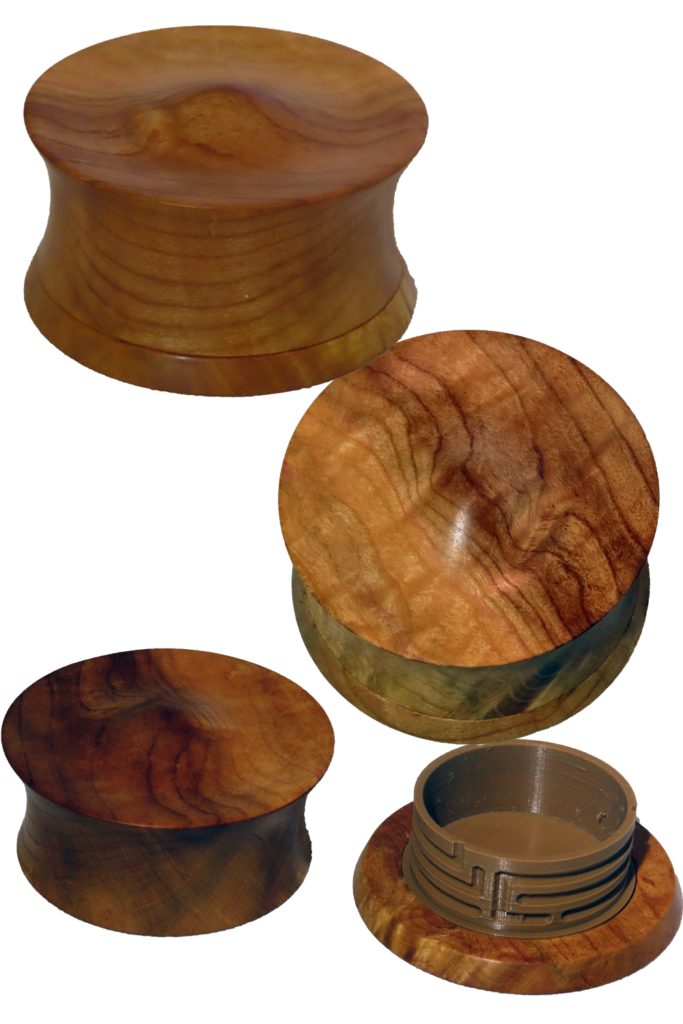
The wood for this project is plum burl salvaged by a wood carver. Unfortunately, he lost his job due to Covid and had to move. The wood could not go with him.
This box has a 3D printed insert. This insert, printed on my Prusa mk3i printer, I have designed to be a simple twist, lift, and back twist pattern. My wife does not want to spend an hour opening her box. It is complex enough to foil a casual thief – but not complex enough for a dedicated thief.
Plus, the plumb wood is pretty.
The box is 3 inches diameter a little over 1.5 inches tall and finished with shellac friction polish.
Enjoy!
Five Options For Woodturning Lathe Faceplates
This is best viewed with the control immediately above this. However, in case of difficulty, it is also posted on YouTube and FaceBook.
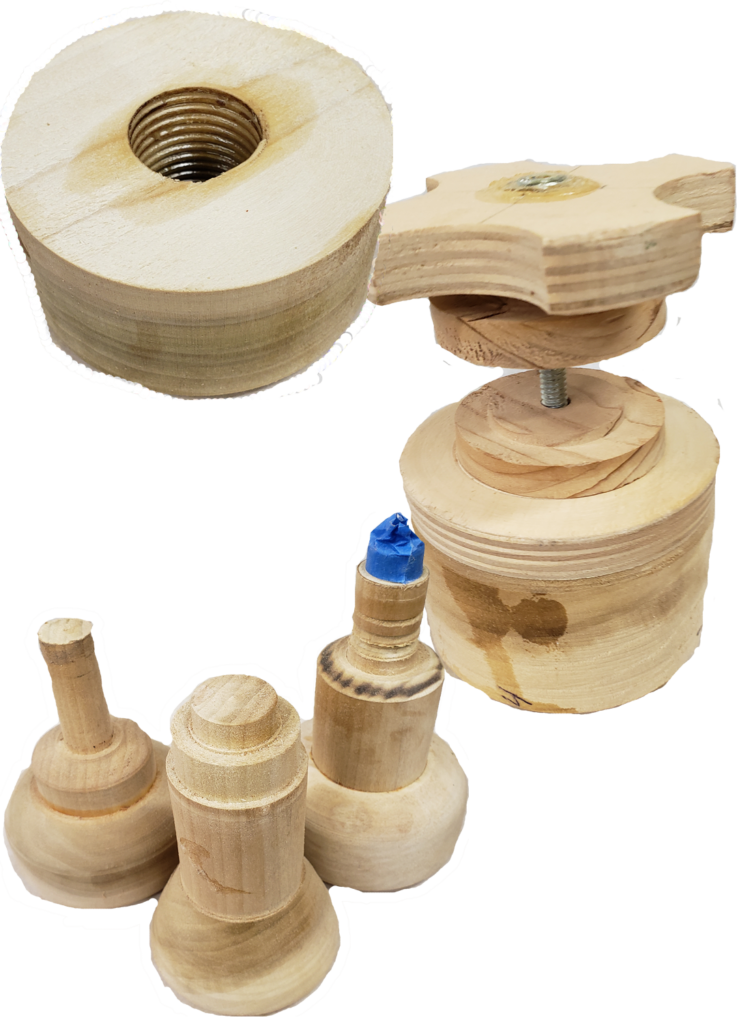
I use a lot of faceplates in many different configurations. I prefer to start with an inexpensive block of poplar, thread it, and then adapt it to my project. When finished, I may face off the base block and put it away until another is needed. I have a box dedicated to my cache of faceplates.
Steel faceplates are too expensive to have a lot of. To add insult to injury, attaching wood requires screws which can ruin my turning tools if hit.
Beyond all steel faceplates, there are two options: a steel nut embedded in wood; direct threading in wood.
For a larger 1 1/4″ x 8 tpi spindle, 8 tpi is not an industry standard. The standard for 1 1/4 threads is 7 threads per ince. Therefore, an 8 tpi nut is a special specification, very expensive and hard to find.
Instead, taps are available for 1″, 1 1/4″, and M33 spindles. Direct threaded into a block of inexpensive poplar is quicker than embedding a nut in wood. Poplar performs well for all my projects.
I’ll show you mine – Please show me yours.
Enjoy!
Live Edge Woodturning – Apple and Pear Box
This video is best viewed with the control above. In case of difficulty, it is also posted on YouTube (link) and FaceBook.
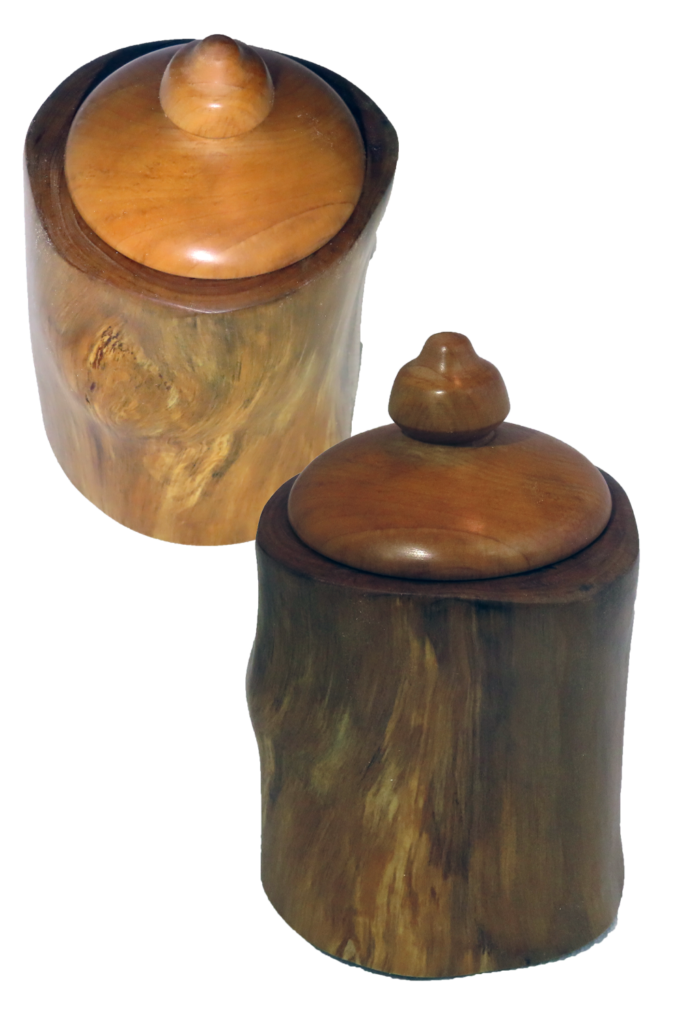
Sometime ago after some annual pruning, I saved an apple limb. Shortly afterwards, I cut it into smaller sections and cored out the pith and center. Then left it to dry.
Now, it is dry and ready to become a box. I only need to refine the inside, add a bottom, and form a top. The bottom is walnut, the lid is pear. All finished with walnut oil then buffed.
The box is about 3.5 inches in diameter and 5 inches tall.
The video where the limb was cored is here:
Preparing Green Apple Branch For Natural Edge Projects
Enjoy!